The Grayers Globster
- Rating
- +60
- Author
- FrankEntropy
- Filed
- Last revised
- Revisions
- 15
- Length
- 1,191 words · 6 min
Contents & file data
There is also the topic of today, the Grayers Globster, which washed up on the shores of the town of Grayers in 2005.
The Grayers Globster

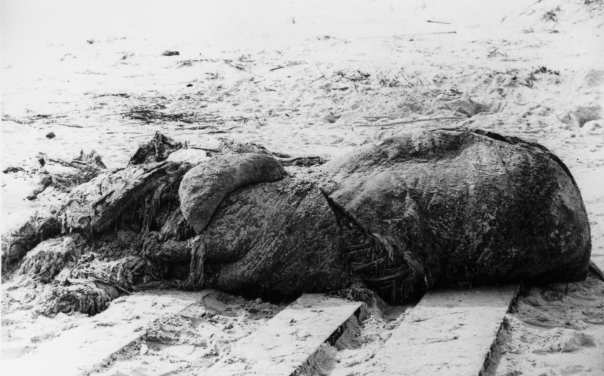
Crowd gathered to see the "St. Augustine Monster" globster, photographed by Van Lockwood.
Have you ever heard of a Globster? They’re a pretty fascinating marine phenomenon. Basically, every so often, a giant blob of rotting organic matter washes up on the shore. Usually, they’re a big fat grey lump spread over the rocks. Sometimes, they’d wash up with a skeleton intact, making it a bit more apparent that they were the remains of some dead sea creature.
Back in the days, it was common for globsters to become media sensations, as they were thought to be sea monsters. They’d make the news, draw national attention, and crowds of people would gather to witness these foul-smelling lumps and theorize what strange cryptid it had been in life.
Of course, almost invariably, these globsters would be identified as nothing more than the corpses of dead whales, or even just the blubber. There are some exceptions, however, such as the Montauk Monster, later identified as a dead, waterlogged raccoon.
There is also the topic of today, the Grayers Globster, which washed up on the shores of the town of Grayers in 2005.
By the early aughts, most of the mystique surrounding Globsters had faded, even among paranormal enthusiasts and cryptozoologists. This fact, however, did not deter the mayor of the small town of Grayers when one such instance washed up on their shore. He thought that pushing a local cryptid story could help revitalize the declining seaside town, even if they had to market a giant blob of wet decayed meat to do so.
The Grayers Globster seemed like a typical sea blob. About the same shape, and four times the size of a squashed beanbag chair, mostly composed out of undifferentiated grayish-pink waterlogged meat. It had a goo-like, liquefied consistency in some places, while others were more solid and lumpy. It was a bit drier than the usual sea blobs, though, which was helpful - the mayor figured that it could last at least a while before it either dissolved, or the smell got too bad.
What followed was probably one of the most surreal marketing campaigns in American history. Local newspapers were encouraged to “speculate on” and “creatively embellish” the origins of the globster, while posters and billboards were put up to advertise the town’s new attraction. Incredibly, efforts to revitalize the town’s tourism were actually somewhat successful (at least at first) as a number of tourists stopped by to take vacation photos of themselves with the Grayers Globster for a small fee.
Initially, the campaign (“Globster Week”) was only meant to last a single week, after which the globster would be disposed of. This was later extended by two more weeks after the campaign went better than expected. This success did not come without controversies, as one would expect from marketing your town via a piece of dead flesh.
Aside from general concerns over hygiene and good taste, there were some objections that were more specific. A number of Grayers children (and some adults) reported nightmares involving the globster, or the sea. A few houses close to the beach lamented that the stench was such that when they opened a window, the very air tasted of salt. One local complained that he was unable to sleep, as he could hear the globster rapidly decomposing, likening it to the sound of incessant whispering in a multitude of voices.
Worse still, security around the globster was lax, with nothing but a perimeter that was often left unguarded. One local whose house faced the perimeter complained that at night, she’d see vandals surrounding the globster, daring each other to touch it. By morning, the Grayers Globster would be missing bits and pieces, carved off by hand or knife, presumably taken as souvenirs. On one occasion, a dozen or so bite marks were discovered. The globster was put under 24/7 CCTV surveillance after that particular incident.
It didn't help matters that the mayor had become overly enthusiastic about Globster Week, claiming that any grievances towards the globster were lies. This was not entirely without merit: Some of the accounts were downright nonsensical, such as claims regarding men in robes chanting at the globster after dark, marks in the sand indicating that the globster had moved in the night. Accounts stating that the globster sang in the early morning, or that it had a face that it showed when no one was around. None of it, he pointed out, had been corroborated by the security footage, and yet the complaints and rumors still came.
The mayor had announced that his plans were to extend Globster Week to a full month. Unfortunately, the initial success of the first week did not last, as tourists stopped showing up towards the end of the second week after a string of especially harsh sunny days. By the time local environmental agencies forced him to bury the globster at the end of the third week, the stench had already become unbearable.
Before the Grayers Globster was buried, a number of samples were finally collected and sent to a local marine biologist. Authorities had refused to allow testing of the globster earlier in order to maintain an air of mystery, instead choosing to push a local paper's joke hypothesis that it was originally a sea cryptid known as the Grand Sea Snake. Excavators were used to bury the globster, and all the advertisements (which now read positively cartoonishly childish) were torn down.
The Grayers Globster was barely in the ground for a week before federal authorities arrived and demanded that it be dug up again.
None of the tissue samples had been traced back to any marine life, whales or otherwise. In fact, it had taken a number of days to verify and re-verify the results, due to how egregious it had been.
From what I’ve heard, they interviewed and issued gag orders to just about the entire town. Special trucks were used to transport the globster to whoever’s job it was to take care of these sorts of incidents at the Federal Bureau of Investigation. During interrogation, the mayor claimed that the idea of Globster Week did not in fact originate from him, but from one of his staffers.
The investigation hit a snag after it was discovered that, while the named staffer did appear on town records, none of the mayor's other staffers, or anyone in town at all, could recall such an individual.
They only ever managed to identify two of the bodies. One had been Australian sailor Edward K. Begg. The other was Ban Park, a Korean lighthouse operator. Begg had been reported missing at sea about two weeks before the Grayers Globster washed up, while Park had gone missing after a shift in 1984.
The remaining 327 individual human bodies that were pulled out of the Grayers Globster were deemed too decayed and waterlogged to ever properly identify. This figure does not include the bodies that authorities were unable to separate.
Referenced by
3 records- HubDecibelles2016+567
- HubYossipossi20210
- HubKate McTiriss20120
In the same hub
Shortest Pages in the Last 30 Days · 25 pages- I Killed My Wife But She's Still There+23
- Inheritance+15
- MTF Alpha-10 "Extraordinary Evidence"+17
- Sushi In Foreign Lands: Canada Edition+18
- The Other Side Of The Glass+27
- I Watched You Enter Your Home From Inside A Dumpster+32
- You Feel a Stillness All Around You, Caressing Your Face+22
- (Maternity Wing Archives|Case Δ-273714 "Scarlet Born")+21